> For the complete documentation index, see [llms.txt](https://tools.osintnewsletter.com/llms.txt). Markdown versions of documentation pages are available by appending `.md` to page URLs; this page is available as [Markdown](https://tools.osintnewsletter.com/osint-tools/baidu-maps.md).
# Baidu Maps
Tool Description : A Chinese digital mapping and navigation platform providing maps, satellite imagery, street-level views, traffic data, and route planning across China and parts of the world.
| **Baidu Maps** | **Quick Overview** |
| ---------------- | ---------------------------------------------------------------------------------------------------------------------------------------------------------------------------------------------------------------------------- |
| URL | |
| What it does | Helps users search for locations, explore cities, view satellite imagery, access street-level views, and get directions for driving, walking, cycling, and public transport, with particularly strong coverage inside China. |
| How to use it | Much like other mapping tools, visit the website, enter a location, address or coordinates, switch between standard, satellite, or street-level view, and then use the directions tool to calculate routes and travel times. |
| Cost | Free. |
| Account required | No. |
| Cookies | Yes. They “use cookies to customise services for each individual user.” |
| Ownership | Baidu Inc. |
| Use in Reporting | Particularly useful for verifying locations inside China, analysing infrastructure, checking business listings, and cross-referencing Chinese-language addresses and place names. |
### **What does Baidu Maps do?**
Baidu Maps is a location-based mapping and navigation platform widely used in China that allows users to search for places, view detailed street maps and satellite imagery, access street-level views, and get real-time traffic and public transport information.
It includes local business listings, user reviews, and live congestion data, with particularly strong coverage and accuracy inside mainland China. The platform uses China’s domestic coordinate system (BD-09), which differs slightly from standard GPS coordinates.
**The lowdown:** Baidu Maps is the go-to digital map for China, offering highly detailed local data, navigation, and street imagery. It’s especially useful for verifying Chinese addresses, analysing infrastructure, and cross-checking locations that may not be accurately represented on Western mapping platforms.
### How to Use:
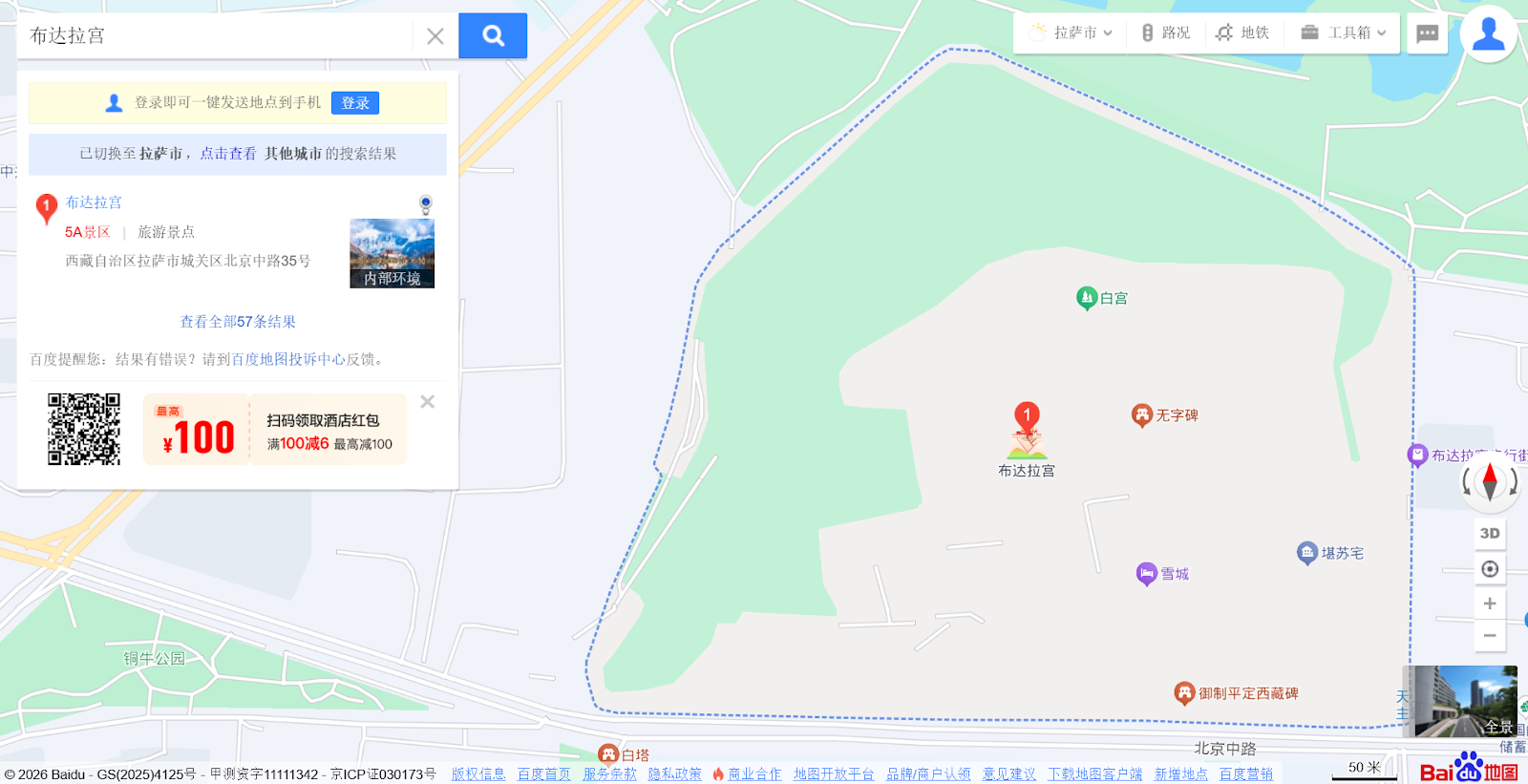
**1. Search for a Location by entering the address or place name in Chinese (results are more accurate in Chinese characters).**
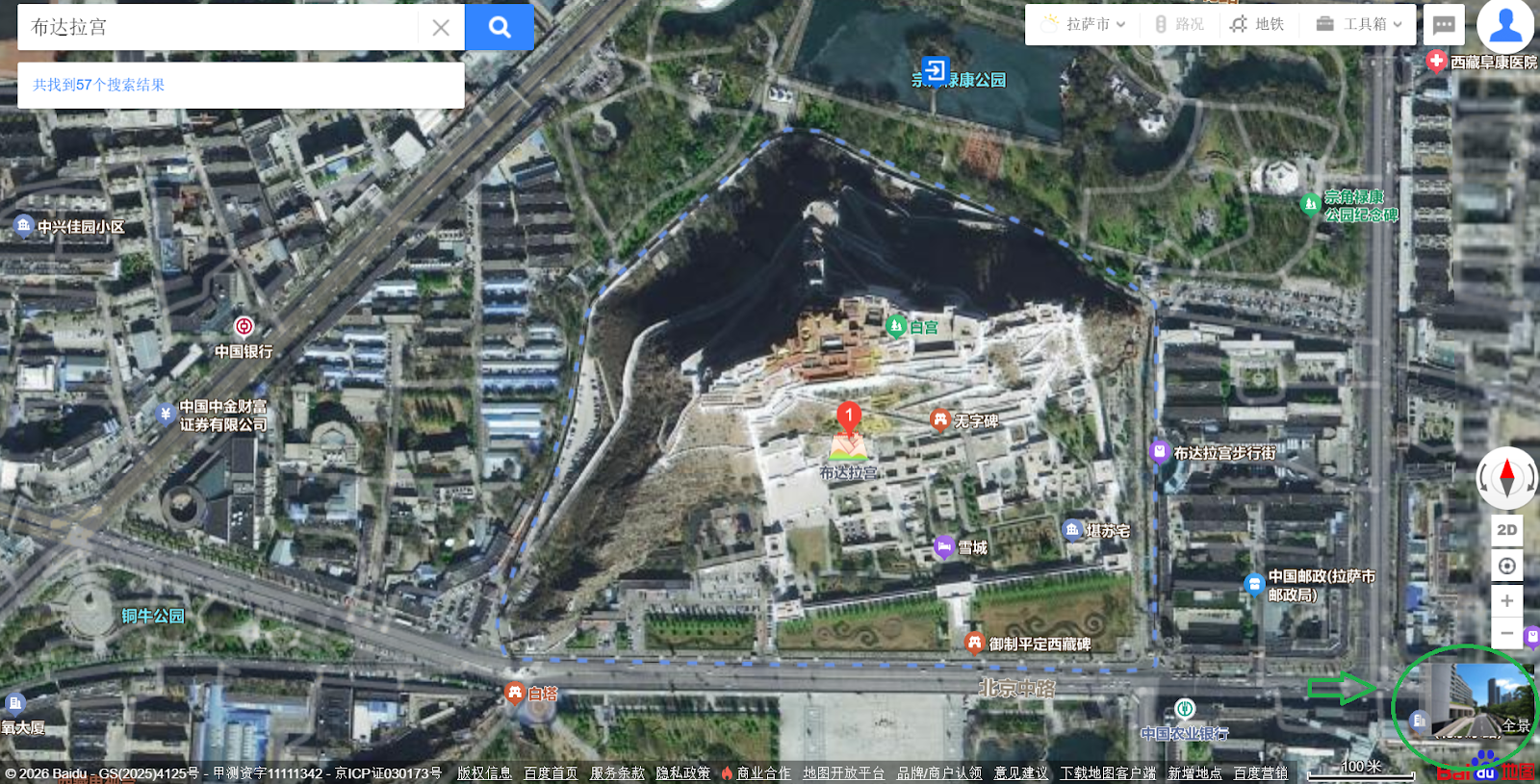
*For example, we’ve searched for Potala Palace by typing in the Chinese characters, 布达拉宫).*
**2. Toggle between standard map view and satellite imagery. Use street-level view if available.**
**3. Zoom in to examine road layouts, nearby buildings, transit links, and landmarks. Cross-check coordinates with other mapping tools if needed.**
You can[ watch this YouTube tutorial here.](https://www.youtube.com/watch?v=-N9mL1XnlB0)
### Cost:
* [ ] Paid
* [ ] Partially Free
* [x] Free
## Data Processing
### Account required:
* [x] Yes
* [x] No
No (basic browsing and searching).
Yes (for saved locations, personalised services, mobile app features).
### Cookies:
According to [Baidu’s privacy policy](https://ir.baidu.com/baidu-statement-privacy-protection/#:~:text=Baidu%20uses%20cookies%20to%20customize,in%20a%20collective%2C%20anonymous%20manner.), they “use cookies to customise services for each individual user.”
### Use in Reporting
Baidu Maps can support reporting by verifying Chinese addresses and landmarks, analysing road networks and infrastructure, confirming proximity between locations, checking business listings in Chinese and supporting geolocation investigations within China.
| **Capabilities** | **Limitations** |
| ------------------------------------ | ---------------------------------------------------------------- |
| Strong mapping detail inside China. | Language barrier - interface is primarily in Chinese. |
| Satellite imagery. | Limited detail outside China. |
| Street-level imagery in many cities. | Coordinate system differs from global GPS (requires conversion). |
| Real-time traffic updates. | No built-in historical imagery comparison. |
| Public transport navigation. | Data environment governed by Chinese regulations. |
### Summary
Baidu Maps is most useful in the geolocation and verification stage of the OSINT workflow, providing more accurate and up-to-date local data than Western alternatives. However, care should be taken re its use of China’s domestic coordinate system and to cross-check findings with other mapping tools to avoid location discrepancies or misinterpretation.
### Ownership
Baidu Maps is owned by Baidu Inc. Baidu was incorporated in January 2000 by [Robin Li](https://en.wikipedia.org/wiki/Robin_Li) (Chinese Software Engineer and billionaire internet entrepreneur) and [Eric Xu](https://en.wikipedia.org/wiki/Eric_Xu) (Chinese entrepreneur, investor, and philanthropist.) Baidu has origins in RankDex, an earlier search engine developed by Robin Li in 1996, before he founded Baidu in 2000. The company is headquartered in the Haidian District in Beijing.
### Ethical Considerations:
* Be mindful of privacy when analysing residential areas.
* Cross-check findings with multiple sources.
* Understand coordinate differences when comparing with GPS-based tools.
* Consider regulatory and data environment differences when reporting.
### Related Tools:
* Gaode Maps
* Google Maps
* [Apple Maps](/osint-tools/apple-maps.md)
#### Sources:
.