> For the complete documentation index, see [llms.txt](https://tools.osintnewsletter.com/llms.txt). Markdown versions of documentation pages are available by appending `.md` to page URLs; this page is available as [Markdown](https://tools.osintnewsletter.com/osint-tools/birdhunt.md).
# BirdHunt
Tool Description : Find tweets based on location, helping you uncover what people were saying in a specific place at a specific time.
| **BirdHunt** | **Quick Overview** |
| ---------------- | ---------------------------------------------------------------------------------------------------------------------------------------- |
| URL | |
| What it does | Finds tweets posted within a specific geographic area. |
| How to use it | Enter a location, set your search radius and timeframe, then hit search and explore tweets on the map. |
| Cost | Free (limited functionality). Paid tiers for advanced use. |
| Account required | No for basic use. Yes for full features. |
| Cookies | Standard tracking and session cookies (Google analytics). |
| Ownership | Developed by HuntIntel and founded by Louis Tomos Evans, based in Cardiff, Wales. |
| Use in Reporting | Used to quickly find location-specific tweets that help verify events, identify eyewitnesses, and build timelines during investigations. |
### What does BirdHunt do?
BirdHunt is a go-to tool for location-based Twitter analysis. It cuts through the noise by letting you zoom in on tweets from a precise location and is especially powerful for fast-moving events where location matters more than hashtags. Instead of keyword guessing, you’re literally working from the ground up.
**The lowdown:** It’s built for investigators, journalists, and researchers who want to track down geolocated tweets quickly and visually. Think: protests, incidents, events, all mapped through Twitter/X activity.
### How to Use:
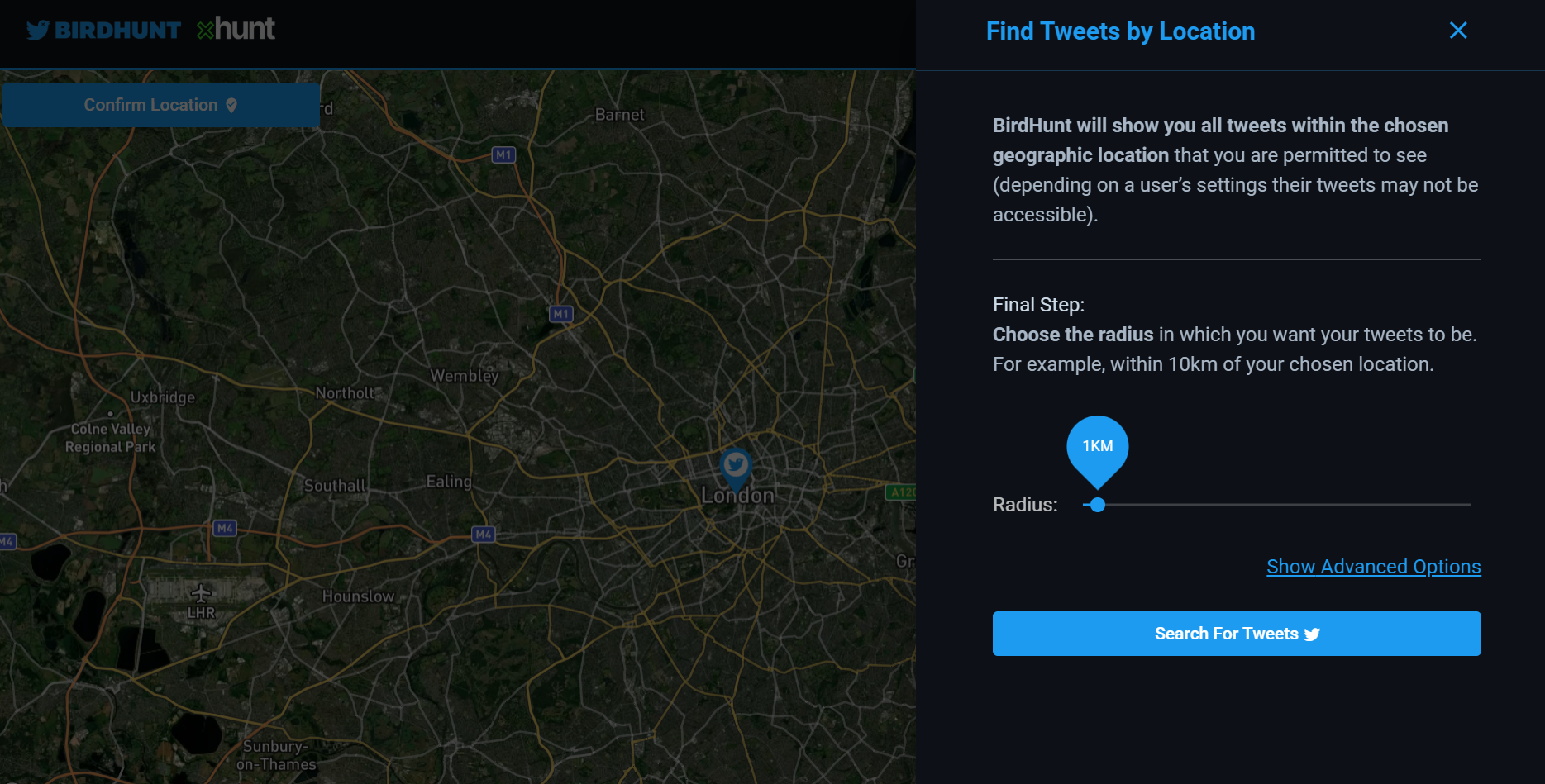
**1. Drop a pin, enter coordinates, or search a place to define your area**.
**2. Refine your search by adjusting the radius and time window to narrow results.**
**3. Twitter/X will then open a new tab with your results.**
You can [learn more in the OSINT Newsletter here. ](https://osintnewsletter.com/p/13)
### Cost
* [ ] Free
* [x] Partially Free
* [ ] Paid
Free (limited functionality). Paid tiers available for advanced use.
## Data Processing
### Account Required:
* [x] Yes
* [x] No
No for basic use. Yes for full features.
### Cookies:
Standard tracking and session cookies are used (Google analytics).
### Use in Reporting
BirdHunt is useful to:
* Verify user-generated content (UGC).
* Locate first-hand accounts.
* Support investigative storytelling.
* Cross-reference with other OSINT tools.
Whilst not usually name-dropped in public reports, its core capability (geolocated tweet discovery) is used in investigations like protest and riot analysis, breaking news verification, timeline reconstruction, and finding eyewitnesses.
| **Capabilities** | **Limitations** |
| ----------------------------------------- | ---------------------------------------------------------------------- |
| Precise geo-based tweet discovery. | Relies on geotagged/location-inferred tweets (not all tweets qualify). |
| Time filtering for event reconstruction. | Dependent on Twitter/X data availability. |
| Visual map interface for easy navigation. | Advanced features are often paywalled. |
| Helps uncover hyper-local conversations. | May require manual verification of findings. |
### Summary
BirdHunt is best used in the collection and analysis stage of the OSINT workflow. If you need to know what people were saying at a specific place and time, it’s a fast, intuitive way to get there, but like all OSINT tools, it works best when paired with verification and other sources.
### Ownership
Developed by HuntIntel and founded by [Louis Tomos Evans](https://x.com/LouisTomosEvans), based in Cardiff, Wales.
### Ethical Considerations
* Respect privacy and consent, especially with individuals.
* Avoid misuse of location-based data.
* Always verify before publishing.
* Be mindful of context and potential harm when using social media content.
### Related Tools:
* GeoSocial Footprint
* TweetDeck (X Pro)
* Google Maps
* Echosec
#### Sources
\