> For the complete documentation index, see [llms.txt](https://tools.osintnewsletter.com/llms.txt). Markdown versions of documentation pages are available by appending `.md` to page URLs; this page is available as [Markdown](https://tools.osintnewsletter.com/osint-tools/geohints.md).
# GeoHints
Tool Description : A visual database of a large number of landmarks and their respective geographic locations.
| **GeoHints** | **Quick Overview** |
| ---------------- | -------------------------------------------------------------------------------------------------------------------------------------------------------------------------------------------------- |
| URL | |
| What it does | It’s an online OSINT reference platform that helps investigators identify geographic locations by analyzing visual clues in photos and videos, particularly from Google Street View–style imagery. |
| How to use it | Browse the site’s categories and compare visual clues in your image to the reference examples to narrow down the location. |
| Cost | Free |
| Account required | No |
| Cookies | Unknown |
| Ownership | Created by Twitch users MouseWithBeer and PV\_93. Independently maintained and community-driven. |
| Use in Reporting | It’s a methodological support tool, rather than something that should be cited as a primary source. |
### **What does GeoHints do?**
GeoHints was initially created to collect and showcase all kinds of different meta and information about different countries to help people learn and get better at Geoguessr.
It’s now also being used as a browser-based OSINT training/reference tool that assists analysts in identifying geographic locations through infrastructure and environmental indicators.
It focuses on country-specific indicators such as road markings, license plates, signage, post boxes, utility poles, bollards, and landscape features. Those pictures are often (but not always) taken from Google StreetView.
**The lowdown:** GeoHints provides categorized visual guides to help determine the likely country or region shown in an image. For OSINT purposes, it is especially useful in geolocation investigations and social media verification.
### How to Use:
1. **Navigate to the** [**GeoHints website.** ](https://geohints.com/)
2. **Select a category (e.g., “License Plates” or “Road Lines”).**
3. **Compare the visual clues in your target image with the reference images provided.**
4. **Narrow down potential countries or regions using elimination.**
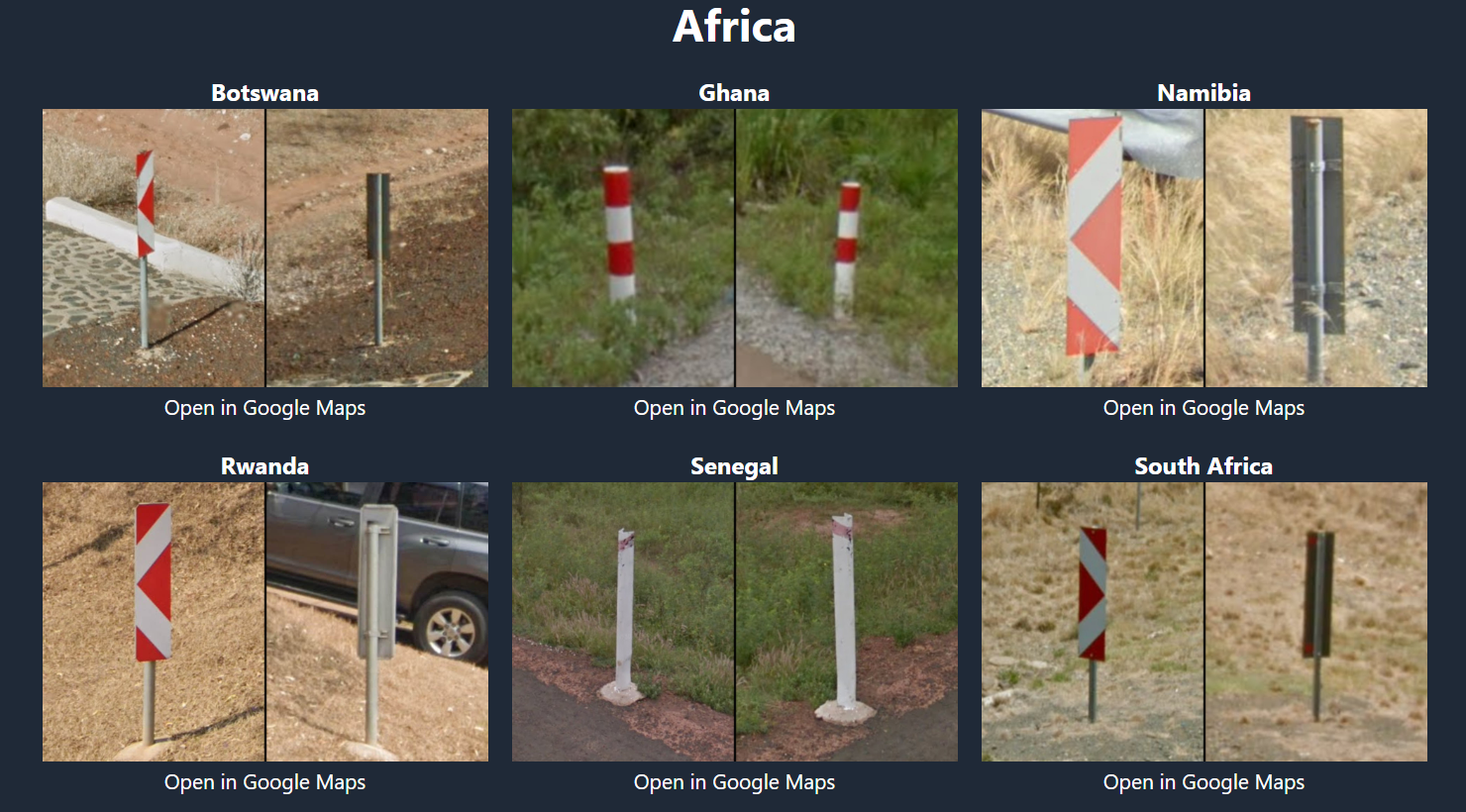
*For example, in our test below, we’ve looked for metal bollards, that have red on them, located in Africa.*
(Assuming we know our image is now somewhere in Africa after clicking through the continents, we could potentially start to pinpoint what country our photo has been taken within, and so on and so forth.)
5. **Make sure to cross-reference findings with other OSINT tools e.g. mapping platforms, satellite imagery, or social media metadata.**
### Cost:
* [ ] Paid
* [ ] Partially Free
* [x] Free
## Data Processing
### Account required:
* [ ] Yes
* [x] No
### Cookies:
Yes, GeoHints web browser uses essential session cookies, basic analytics cookies and performance cookies.
### Use in Reporting
GeoHints can be useful in reporting when verifying the geographic location of user-generated content (UGC) by analysing visible infrastructure and environmental clues in images or videos.
| **Capabilities** | **Limitations** |
| ---------------------------------------------- | ----------------------------------------------------------------------------------------------------------- |
| Country-level geolocation assistance. | Not always fully up-to-date (and limited transparency on update frequency) |
| Structured comparison of infrastructure types. | No image upload or automated matching. |
| Supports elimination methodology. | Relies on user interpretation. |
| Improves pattern recognition skills. | Usually more effective for identifying a country rather than pinpointing a specific city or exact location. |
### Summary
Best used in the geolocation and visual verification stage of an investigation, GeoHints helps identify countries by comparing infrastructure, road markings, signage, and environmental clues in images or video. However, it should be treated as a comparative aid rather than standalone evidentiary proof.
### Ownership
Geohints is a website [created by Twitch Users MouseWithBeer and PV\_93](https://m.twitch.tv/geohints/about) and is an independently maintained community-driven website. Public ownership details are limited, and it does not appear to be operated by a major commercial entity.
[MouseWithBeer](https://www.twitch.tv/mousewithbeer/about) looks like they operate on Central European Time, and [PV\_93 ](https://www.twitch.tv/pv_93)is a 31-year-old gamer from the Netherlands.
### Ethical Considerations:
* Geolocation techniques should not be used to identify private individuals’ homes or enable harassment, stalking, or doxxing.
* Clearly document the visual indicators relied upon rather than presenting conclusions without explanation.
* In conflict or high-risk environments, publishing precise locations may endanger individuals or communities.
* Infrastructure similarities across countries can lead to misidentification so analysts should corroborate findings with multiple independent sources.
### Related Tools:
* Plonk It
* Geonames
#### Sources: